|
Nilorea Library
C utilities for networking, threading, graphics
|
|
Nilorea Library
C utilities for networking, threading, graphics
|
Splits two texts into lines and produces the shortest edit script turning the first into the second, using Myers' greedy algorithm with a stored trace. More...
Data Structures | |
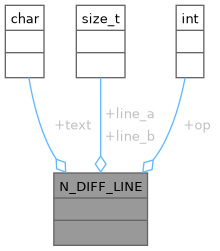
| struct | N_DIFF_LINE |
| one line of an edit script More... | |
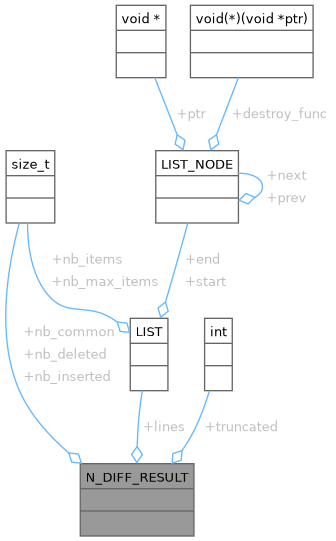
| struct | N_DIFF_RESULT |
| edit script turning one text into another More... | |
Macros | |
| #define | N_DIFF_COMMON 0 |
| the line is present in both texts | |
| #define | N_DIFF_CONTEXT_FULL ((size_t)-1) |
| n_diff_to_unified() context asking for every common line, without hunk headers | |
| #define | N_DIFF_DELETE 1 |
| the line is only in the first text | |
| #define | N_DIFF_INSERT 2 |
| the line is only in the second text | |
| #define | N_DIFF_MAX_EDITS_CEILING 4000 |
| hard ceiling n_diff_lines() clamps max_edits to, keeping the worst case trace under about 64 MB | |
| #define | N_DIFF_MAX_EDITS_DEFAULT 1000 |
| n_diff_lines() default ceiling on the number of differing lines searched | |
| #define | N_DIFF_NO_LINE ((size_t)-1) |
| N_DIFF_LINE line_a / line_b value when the line has no counterpart there. | |
Functions | |
| N_DIFF_RESULT * | n_diff_lines (const char *text_a, const char *text_b, size_t max_edits) |
| Compare two texts line by line. | |
| void | n_diff_result_free (N_DIFF_RESULT **result) |
| Free an edit script and every line it holds. | |
| N_STR * | n_diff_to_unified (const N_DIFF_RESULT *result, size_t context) |
| Render an edit script as unified diff text. | |
Splits two texts into lines and produces the shortest edit script turning the first into the second, using Myers' greedy algorithm with a stored trace.
Unlike an index aligned comparison, inserting one line does not report every following line as changed.
Line splitting: texts are cut on '
'. A trailing newline closes the last line instead of opening an empty one, so "a\nb\n" and "a\nb" both yield two lines and compare equal. Carriage returns are kept, so a text that switched from LF to CRLF shows up as a difference rather than being silently normalised.
Cost control: the forward pass keeps one trace snapshot per edit, so memory grows with the square of the edit script length. n_diff_lines() therefore refuses to search past max_edits differing lines; when the two texts are further apart than that it falls back to reporting the whole differing region as deleted-then-inserted and sets N_DIFF_RESULT.truncated. The result is always a valid edit script, only a coarser one. Identical leading and trailing lines are matched before the search starts, so the limit applies to the part that actually differs.
| struct N_DIFF_LINE |
| struct N_DIFF_RESULT |
edit script turning one text into another
| Data Fields | ||
|---|---|---|
| LIST * | lines | LIST of N_DIFF_LINE*, in output order. |
| size_t | nb_common | number of N_DIFF_COMMON lines |
| size_t | nb_deleted | number of N_DIFF_DELETE lines |
| size_t | nb_inserted | number of N_DIFF_INSERT lines |
| int | truncated | 1 when the edit limit was hit and the differing region was reported as one delete run followed by one insert run |
| #define N_DIFF_COMMON 0 |
the line is present in both texts
Definition at line 65 of file n_diff.h.
Referenced by _emit(), _myers(), n_diff_lines(), and n_diff_to_unified().
| #define N_DIFF_CONTEXT_FULL ((size_t)-1) |
n_diff_to_unified() context asking for every common line, without hunk headers
Definition at line 75 of file n_diff.h.
Referenced by expect_unified(), main(), and n_diff_to_unified().
| #define N_DIFF_DELETE 1 |
the line is only in the first text
Definition at line 67 of file n_diff.h.
Referenced by _emit(), _myers(), _op_char(), main(), n_diff_lines(), and n_diff_to_unified().
| #define N_DIFF_INSERT 2 |
the line is only in the second text
Definition at line 69 of file n_diff.h.
Referenced by _myers(), _op_char(), main(), n_diff_lines(), and n_diff_to_unified().
| #define N_DIFF_MAX_EDITS_CEILING 4000 |
hard ceiling n_diff_lines() clamps max_edits to, keeping the worst case trace under about 64 MB
Definition at line 82 of file n_diff.h.
Referenced by n_diff_lines().
| #define N_DIFF_MAX_EDITS_DEFAULT 1000 |
n_diff_lines() default ceiling on the number of differing lines searched
Definition at line 78 of file n_diff.h.
Referenced by n_diff_lines().
| #define N_DIFF_NO_LINE ((size_t)-1) |
N_DIFF_LINE line_a / line_b value when the line has no counterpart there.
Definition at line 72 of file n_diff.h.
Referenced by _myers(), main(), and n_diff_lines().
| N_DIFF_RESULT * n_diff_lines | ( | const char * | text_a, |
| const char * | text_b, | ||
| size_t | max_edits ) |
Compare two texts line by line.
| text_a | The first text. NULL is treated as empty. |
| text_b | The second text. NULL is treated as empty. |
| max_edits | Ceiling on the number of differing lines to search for, or 0 for N_DIFF_MAX_EDITS_DEFAULT, clamped to N_DIFF_MAX_EDITS_CEILING. Past it the differing region is reported coarsely and truncated is set. |
Definition at line 252 of file n_diff.c.
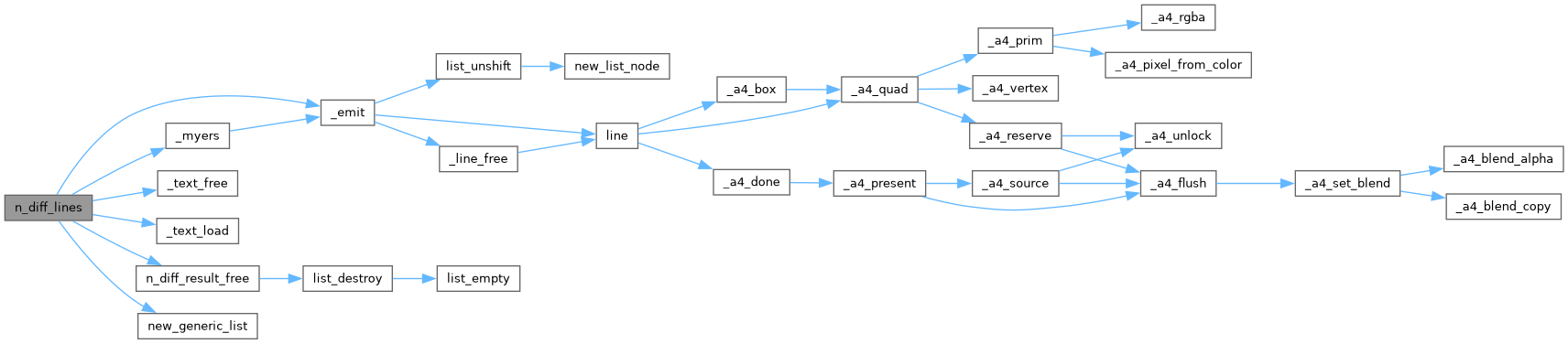
References _emit(), _myers(), _text_free(), _text_load(), DIFF_TEXT::count, DIFF_TEXT::line, N_DIFF_RESULT::lines, Malloc, MAX_LIST_ITEMS, N_DIFF_COMMON, N_DIFF_DELETE, N_DIFF_INSERT, N_DIFF_MAX_EDITS_CEILING, N_DIFF_MAX_EDITS_DEFAULT, N_DIFF_NO_LINE, n_diff_result_free(), new_generic_list(), and N_DIFF_RESULT::truncated.
Referenced by expect_unified(), and main().
| void n_diff_result_free | ( | N_DIFF_RESULT ** | result | ) |
Free an edit script and every line it holds.
| result | Pointer to pointer, set to NULL on return. |
Definition at line 333 of file n_diff.c.
References FreeNoLog, and list_destroy().
Referenced by expect_unified(), main(), and n_diff_lines().
| N_STR * n_diff_to_unified | ( | const N_DIFF_RESULT * | result, |
| size_t | context ) |
Render an edit script as unified diff text.
Each line is prefixed with ' ', '-' or '+'. With a finite context the output is cut into hunks introduced by a "@@ -a,b +c,d @@" header and common lines further than context away from a change are dropped; with N_DIFF_CONTEXT_FULL every line is emitted and no header is written.
| result | The edit script. Must not be NULL. |
| context | Common lines kept around each change, or N_DIFF_CONTEXT_FULL. |
Definition at line 391 of file n_diff.c.
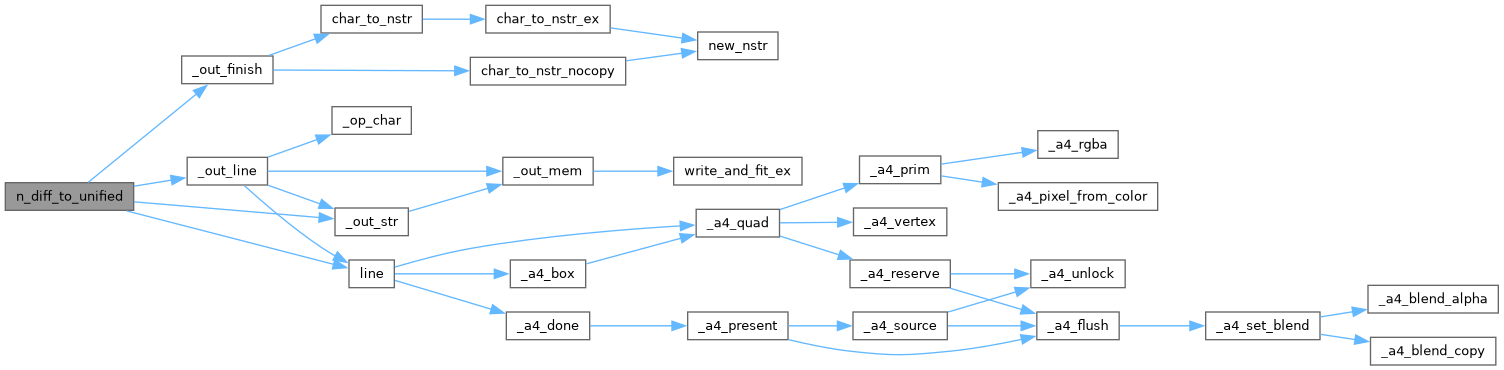
References __n_assert, _out_finish(), _out_line(), _out_str(), DIFF_OUT::buf, DIFF_HEADER_BUF, FreeNoLog, last, line(), N_DIFF_RESULT::lines, list_foreach, Malloc, N_DIFF_COMMON, N_DIFF_CONTEXT_FULL, N_DIFF_DELETE, N_DIFF_INSERT, LIST::nb_items, and N_DIFF_LINE::op.
Referenced by expect_unified(), and main().
 1.15.0