Shooting practice, on the wrist. Nineteen disciplines, two languages, and a watch that keeps the time so you do not have to.
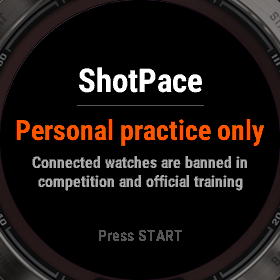
Personal practice only
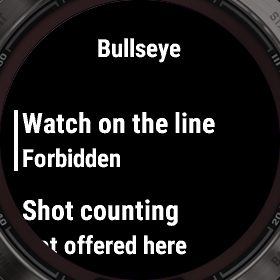
The TAR rulebook forbids connected watches on the firing line during competitions and official training. ShotPace is built for personal practice outside any official setting.
One governing body does permit a device on the line under conditions, and that is recorded in the app per discipline. Permission is still not endorsement: a Match Director sits above any rulebook, and your club's bylaws can be stricter than the federal ones. Verify locally.
What it does
ShotPace runs the timed sequences of nineteen shooting disciplines and signals every transition by vibration, tone and flashlight, so you never have to look at the screen while you are on the firing line.
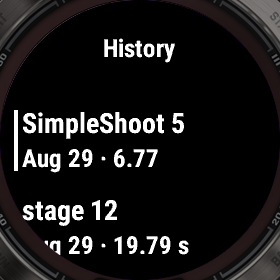
It records what you shot, keeps the history on the watch, and writes a FIT activity where a session is long enough to be one. Scores from different disciplines are never totalled or ranked against each other: points, hit factors, raw times and group sizes are not comparable quantities.
The range officer's words stay in the range officer's language
The interface is in English or French, whichever your watch is set to. A discipline's own vocabulary is not translated: it is shown in the language that competition is actually conducted in.
So a French shooter running the interface in English still reads TIREZ, and an English speaker still reads Standby and Hit factor when running the interface in French. These are the words someone will shout at you, and learning the wrong reflex is a safety problem rather than a cosmetic one.
SimpleShoot is the exception that proves the rule: it is not a competition, has no federation and no range officer, so every word of it is translated normally.
Shot detection is experimental
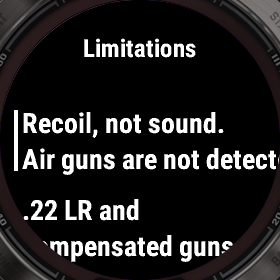
The watch can count your shots from the recoil impulse in its accelerometer. There is no microphone on any Connect IQ device, so this is not acoustic detection and never will be.
It is off by default and stays behind a limitations screen you have to read. It is not a certified timer, it will not catch every shot, and no recoil means no detection at all: air rifles and 10 m ISSF are outside it by physics. Every count it produces can be corrected before it is saved, and a count never writes a score on its own.
Whether it is worth anything depends on the discipline, not on the detector, so each one declares what a count is worth there and the counter is hidden rather than degraded where the conditions do not hold. Do not use it where a score depends on the count.
Which watches, and how well each one is tested
ShotPace was built for the fenix 7X and its round 280 x 280 screen. It also runs on every watch that shares that screen, on the smaller ones in the same line - fenix 7, 7S and the 47 mm fenix 8 Solar and 9 Pro Solar - and, since 1.1.6, on the AMOLED watches: fenix 8, fenix 8 Pro, fenix 9, fenix 9 Pro, fenix E, epix and epix Pro, tactix, quatix, Forerunner, Venu, vivoactive and Instinct 3 AMOLED. The store shows the full list.
Those two groups are not tested to the same degree, and it is fairer to say so than to let you find out. Every screen in this app is drawn and measured at the moment it appears rather than placed at fixed coordinates, so a smaller screen makes the text smaller instead of cutting it off. That is why the smaller watches are offered at all. It is an argument about how the app is written, not a photograph of it running: the screenshots on this page were taken on a 280 x 280 screen, and nobody has yet seen these screens on a 240 or 260 pixel one.
So if something is cut off, overlapping or unreadable on your watch, that is a bug and it is worth telling us about. It is not something you are expected to work around, and it is not a sign the app was not meant for your watch.
One difference is deliberate rather than accidental. The fenix 7, 7S, Forerunner 955 and Forerunner 255 have no flashlight, so the flashlight cue does not appear in Settings on those watches. Vibration and tone work everywhere, and vibration is the one that matters with hearing protection on.
One group carries a bigger question than the others, and it is fair to name it. The AMOLED watches have a screen that lights and blanks differently from the fenix 7X's. This application is built so that you never have to look at your watch during a string - it vibrates and it beeps - but it still has to stay readable when you do look. ShotPace is developed on a fenix 7X Pro and that is the only watch its author owns, so that question can only be answered by someone who shoots with one of the others. If a screen dims, blanks or is hard to read during a sequence on your watch, please say so: on those models your report is the only way anyone finds out.
What it asks for
Three permissions, and it still runs if you refuse any of them. FIT and FitContributor write the activity you see in Garmin Connect. Sensor is the accelerometer, used only for detecting shots by recoil.
Nothing leaves the watch. There is no account, no network call and no telemetry.
CMP As-Issued Military Rifle - Garand, Springfield, Vintage Military
The one discipline whose governing body says a watch is allowed. CMP rule 4.4.9 lets a competitor use a device on the firing line to keep time or record shots - provided it is silent and in airplane mode. Every other rulebook in this app either forbids a worn device or says nothing at all. The discipline's own screen states the conditions, because using a device to communicate is a warning and possible disqualification.
Course A and Course B, at 200 yards: five sighters and ten prone in fifteen minutes, ten rapid prone in eighty seconds, ten standing in ten - or the fifty-shot version, with a sitting rapid stage at seventy seconds between them.
Plus the Benchrest VMR match: five sighters and thirty record shots at 300 yards in half an hour.
The preparation periods are the rulebook's, including the one that sometimes is not there. Two minutes to come to the line and three to prepare - except that the two disappear when the position has not changed, which is what the book says and what the app does.
The full command sequence in the CMP's own words, from TAKE YOUR POSITIONS ON THE FIRING LINE to CLEAR ALL RIFLES, INSERT SAFETY FLAGS AND GROUND YOUR RIFLES, with the three READY commands three seconds apart.
Tell it whether your range has pit-operated or fixed targets and the rapid stages follow rule 4.1.8: eighty seconds becomes eighty-three where there is no pit crew.
Score it as a card is written - 295-12X - with the X count that breaks ties.
A benchrest group entered digit by digit, to a thousandth of an inch
The discipline the watch reproduces most exactly. The IBS range officer counts the last two minutes down aloud, in words rule III.3(b) dictates: 2 minutes, 1 minute, 30 seconds, 15 seconds, 10 seconds, 5 seconds, cease fire. The app gives all six, by vibration as well as on the screen, so you get them without coming off the rifle.
The exact opposite of F-Class, from the same kind of range. There the officer is forbidden to volunteer the time; here they are required to call it. Both books are obeyed as written.
Rule V.E's four allowances, and it says there shall be no exception to them: ten minutes for a five-shot match and fifteen for a ten-shot one at the first match of the day or after a change of distance, seven and twelve for every other. The setup screen shows which one you are about to shoot before you start it.
Heavy Varmint, Light Varmint, Sporter and Heavy Benchrest, at 100, 200 and 300 yards or 100 and 200 metres. Ten-shot groups are offered in Heavy Benchrest and nowhere else, because that is where rule V.A puts them.
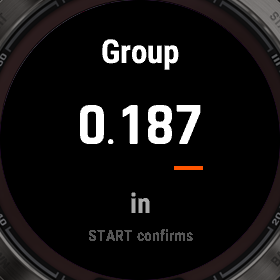
The score is a measurement, not a count. Groups are measured to a thousandth of an inch, centre to centre of the two widest shots, so the app takes four digits - 0.187 - in four presses rather than rounding to something the sport does not use. At a yard distance it gives you the MOA beside it, using the rulebook's own conversion.
The commands and the countdown stay in English in the French app, because that is what the book prints and what a range officer says.
A Bullseye course firing, with the rounds, distance and target under the clock
All six courses of rule 7: National Match, NRA Short, Camp Perry, Marksman League, and the Gallery Course at both 50 feet and 20 yards. Thirty rounds, three hundred points.
The range officer's own sequence, in capitals because that is how it is called: THE PREPARATION PERIOD STARTS NOW, LOAD, IS THE LINE READY?, READY ON THE FIRING LINE, COMMENCE FIRING, CEASE FIRING.
The rulebook's own intervals, not ours. Three minutes of preparation and about three seconds between the last command and the signal are in the rules, so the app does not let you change them - unlike TAR, where the pauses between commands are the app's invention and every one of them is yours to set.
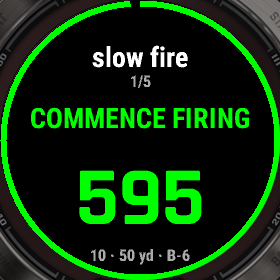
The screen says how many rounds, at what distance and on which target, because a Precision Pistol course moves: the National Match Course starts at 50 yards on a B-6 and finishes at 25 on a B-8.
Score entry ring by ring, offering only the rings that target carries.
An F-Class result in the sport's own notation, rings checked against the shots
The one discipline the watch never interrupts. F-Class range officers do not call the time - you ask them for it - so the app does not either. No countdown, no vibration, no tone. The clock runs and logs how long the string took, and says nothing.
Six courses, 300 to 1000 yards, ten or fifteen shots.
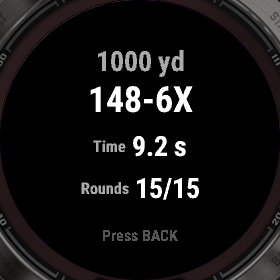
Enter the rings you shot - X, 10, 9, 8, 7, 6, 5 - and it gives you 148-6X in the sport's own notation, with the ring count checked against the shots so a scorecard that does not add up says so.
The four CMP courses: the President's Course at thirty shots, the National Match Course at fifty, the Standard Course at eighty and the Long Course at a hundred. The menu says how long each one takes before you commit to it - 37 minutes to 98.
Across the course means the relay moves, and so does the screen: 200 yards standing, 200 or 300 rapid, 600 prone. The distance sits under the clock because it changes three times.
Both preparation periods, before every stage, exactly as rule 4.7 gives them: two minutes to come to the line, three to prepare.
Rapid stages fired as two series where the book says two - the Standard and Long courses run their sixty- and seventy-second series twice, with a fresh loading command and ready sequence between them, and the screen says which series you are on.
Tell it which match you are shooting and the commands follow: a National Trophy event has no sighters and stands to load, a CMP Cup match starts in position. The book supplies a separate range officer script for each and so does the app.
Tell it whether your range has pits and the rapid series follow rule 4.7.5: sixty seconds becomes sixty-three where there is no pit crew.
Score it as a card is written - 485-22X - with the X count that breaks ties.
CMP rules permit a device on the firing line to keep time or record shots, provided it is silent and in airplane mode. The discipline's own screen states the conditions.
ICORE's division list, each row saying what a B zone hit will cost
Total time, ICORE's way: your raw time, plus what the targets cost - a B zone hit is a second, a C is two - plus five seconds for each penalty and thirty for a missed stop plate.
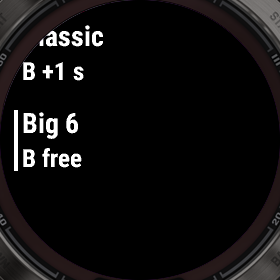
The division changes the arithmetic, and the app says so before you pick. Rule 7.4.3 gives Big 6 a B zone that costs nothing where every other division pays a second for it, so the same shooting scores differently. Each row on the division list carries what a B will cost you.
The result separates what the clock cost from what the targets cost, because with accuracy denominated in seconds a single total hides the thing worth learning.
Make ready., Are you ready?, Stand by. - chapter 2's words in chapter 2's own spelling, which is not the same as any other discipline's here.
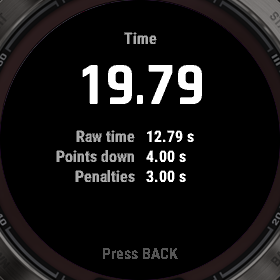
An IDPA result: the total, the raw time, the points down and the penalties
A shot timer with IDPA's own arithmetic: your raw time, plus a second for every point down, plus five seconds for each hit on a non-threat, three for each procedural, ten for a flagrant and twenty for a failure to do right.
The result shows the total and the three parts that made it - raw time, points down, penalties - because that is the whole idea of the scoring and a single number would hide it.
Say how many scoring hits the stage asks for, shoot it, then walk the targets and enter what you find.
Standby is followed by the start signal one to four seconds later, and silence after Are You Ready? counts as ready - both the rulebook's, not ours.
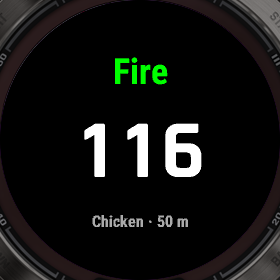
An IMSSU bank being shot, with the animal and the distance
The same sport as above, under the other governing body, and they are not interchangeable. IMSSU is what most of the world outside the United States shoots, and France among them: FFTir publishes no silhouette rules of its own, only this book in translation.
All English, including the targets - chicken, pig, turkey, ram. That is the reverse of the NRA discipline above, whose American rulebook keeps the Spanish names. The commands are English by IMSSU's own rule: at International level, all range commands must be given in English.
Five commands where the NRA has three: Shooters to the line, Load, Fire, Cease fire / Make your firearms safe, Range is clear. The watch calls all five, and makes the firearm safe after every bank including the last.
Five categories - Big Bore Pistol, Small Bore Pistol, Field Pistol, Big Bore Rifle, Small Bore Rifle - each with its own four distances. Thirty seconds to load, then two minutes to fire for the pistols and two and a half for the rifles.
One thing to set, and only one: how long you need between banks to clear the line and stand the silhouettes back up. Every other interval is the rulebook's. The book gives that gap no duration because it depends on the range, so it is yours.
Scored out of forty, the way the classification tables are written.
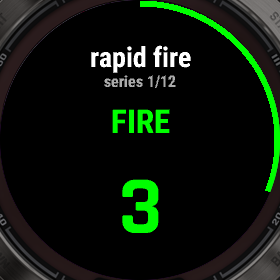
An ISSF 25 m series, with its series counter and countdown
Four events under one rulebook: 25 m Standard Pistol, Rapid Fire Pistol, Sport Pistol and Centre Fire Pistol. Sixty shots, six hundred points.
The series the rules give: 150, 20 and 10 seconds for Standard Pistol, 8, 6 and 4 for Rapid Fire.
Sport Pistol's rapid stage is not a countdown. The target shows for three seconds, hides for seven, and does that five times a series - one shot each time. The watch counts it out for you.
Every interval is the rulebook's: three minutes to prepare, a minute after LOAD, seven seconds after ATTENTION, a minute between series. There is nothing to set, and the settings screen says so rather than pretending otherwise.
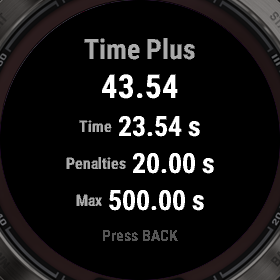
A Multigun result, with the scoring system named because the rulebook publishes two
Time Plus scoring: your raw time plus five seconds for a failure to neutralise, engage, hit a no-shoot or take a procedural; ten for no hits at all on a target; fifteen or twenty on a long-range enhanced-penalty target; and sixty for a spinner you did not spin.
You enter penalties by what they cost, not by name - 5 s, 10 s, 60 s. Nine rules, five prices, and the arithmetic cannot tell four five-second penalties apart anyway.
A stage cannot score worse than five hundred seconds, and a stage briefing can set a lower limit down to three minutes. The result says which.
This rulebook has two scoring systems and the app times one. USPSA Multigun may be scored Time Plus or by traditional hit factor, and the choice binds a whole match. The app computes Time Plus and its result screen says so; it does not time a hit-factor multigun match.
Sixteen MLAIC events: Miquelet, Maximilian, Minie, Whitworth, Cominazzo, Kuchenreuter, Colt, Walkyrie, Mariette, Tanegashima, Vetterli, Hizadai, Donald Malson, Tanzutsu, Pennsylvania and Lamarmora, each with its distance and target.
Five minutes to prepare and thirty to fire, which is the whole of rule 4.4 b) - and which the app times, because thirteen shots in half an hour is a clock even if it is a gentle one.
It buzzes where the range whistles. MLAIC starts a relay with two blasts and ends it with one long one; the rule allows "a whistle or similar audible instrument", and a watch on your wrist is exactly that, minus the audible.
It does the dropping for you. Thirteen shots are fired and the highest ten count, so enter the rings you shot and the score is out of a hundred, with the three the rulebook throws away shown separately.
The two MLAIC targets have different rings - the C50 scores down to one, the musket target down to five - so the score entry asks for the rings the target you shot at actually has.
A PRS result: impacts out of shots. The only score here that is a count out of a count
The simplest scoring in the app, because the rulebook insists on it. One impact is one point. PRS forbids half points, bonus points and point deductions outright - so there is nothing to add and nothing to subtract, and the result is a count out of the round count.
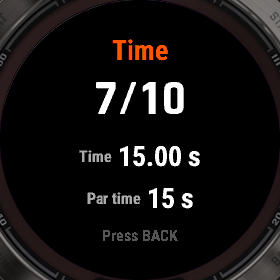
The par time ends the stage rather than measuring it. When it expires the watch shows Time, which is what the range officer calls; when you finish early it shows the time you took.
The start signal comes one to three seconds after Stand by - PRS's own window, and narrower than the one to four seconds most practical disciplines use.
There is no Off on the par: a PRS stage without one is not a PRS stage.
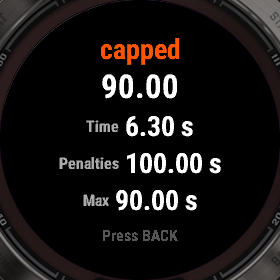
A SASS stage that hit its own ceiling, captioned as capped
Total Time scoring: your raw time plus five seconds a miss, ten for a procedural or a minor safety violation, thirty for a failure to engage.
A stage cannot score worse than its own ceiling. SASS sets the maximum for a stage at five seconds per target plus thirty, and the app computes it as you set the target count - so you can see what a bad stage costs before you shoot it, and the result says capped rather than quietly disagreeing with its own arithmetic.
One procedural per stage, because the rulebook says so. That counter stops at one; the others run to the target count.
No range commands, because SASS has none. The handbook times a stage from the beep once you have signified ready, so that is what the app does: a prompt, a silent wait, a beep.
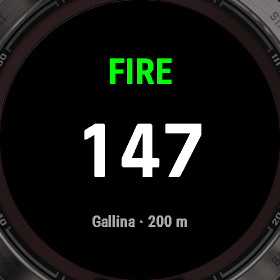
A silhouette bank being shot, with the animal and the distance
The four targets keep their Spanish names in both languages of the app - Gallina, Javelina, Guajalote, Borrego. Metallic silhouette came out of Mexico and the NRA's own English rulebook names them that way. The commands are the rulebook's English: READY, FIRE, CEASE FIRE.
Seven programmes - High Power, Black Powder Cartridge, Smallbore, Air Rifle, Lever Action, Pistol, Air Pistol - each with its own four distances and its own two clocks, all of them the rulebook's.
The watch runs the whole course of fire: a bank of five silhouettes, the ready period before it, the reset gap after it, eight banks from Gallina at the near distance to Borrego at the far one. It shows which animal and how far while you are shooting it.
Nothing to configure. Rule 8.2 fixes every interval this discipline has.
For the practice that is none of the above: a random delay, a start signal, a clock that runs until you stop it or until the par time does.
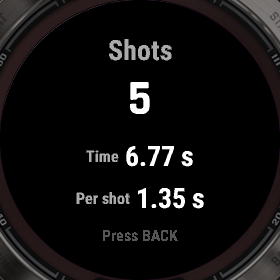
Afterwards you enter how many shots you fired, and it keeps the time, the count and the time per shot.
No rulebook, no zones, nothing to describe before you start. Press start and shoot.
Every transition vibrates as well as sounds. Behind hearing protection, vibration is the
cue that gets through. Each command has its own pattern, told apart by counting the pulses,
and you can reassign any of them - the pattern buzzes as you pick it. The app warns you
before a sequence if the watch will not vibrate.
Steel Challenge - SCSA
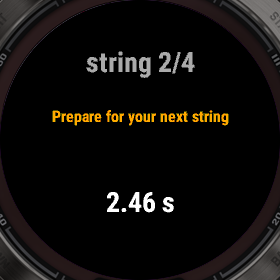
Steel Challenge between strings, and what the last one took
All eight official stages: 5 to Go, Showdown, Smoke & Hope, Outer Limits, Accelerator, The Pendulum, Speed Option and Roundabout.
Five strings each, and the worst one is thrown away - except Outer Limits, which is four strings and the best three. The menu says which is which before you pick.
The rulebook's own thirty-second ceiling: a string that runs long stops itself and scores thirty seconds, which is what the rules say happens whether you ran out of time or never hit the stop plate.
Afterwards you enter how many standard plates you missed on each string. Three seconds each, added to that string, and the ceiling still applies.
The range officer's sequence, in English: Make ready, Are you ready?, Stand by, then the start signal one to four seconds later - the interval the rulebook specifies, not one the app invented.
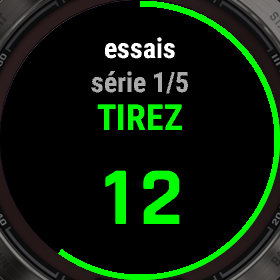
A TAR sequence mid-string: TIREZ, the countdown and the arc
All thirteen events of the CNS TAR catalogue, from 810 to 832, with the round counts and durations of the current rulebook.
The range commands in French, as they are actually called: CHARGEZ, PRÊT, TIREZ, STOP, DÉCHARGEZ. They are never translated, because a shooter training for a French event has to learn TIREZ and not "Fire".
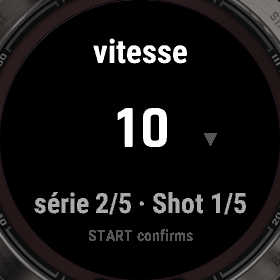
Score entry by zone or by gongs, offering only the values the target can produce.
A shot timer that follows the IPSC sequence: Load and make ready, Are you ready?, Standby, then a start signal after a delay you cannot anticipate.
Par time, or a free-running clock you stop yourself.
Save a stage you shoot often and run it again in one press.
A / C / D hits at Minor or Major power factor, misses, no-shoots and procedurals, and the hit factor they come to - floored at zero, as the rulebook says.
Two rulebook profiles for course sizes, because clubs do not all publish the same revision, plus a free profile that checks nothing.
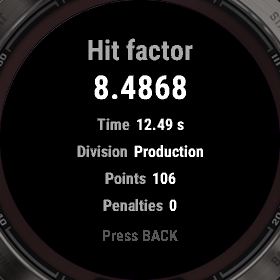
A USPSA result: the hit factor, and the division beside it
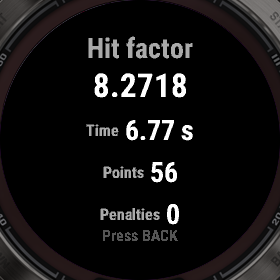
Hit factor, USPSA's way: points over time, A/C/D scored at minor or major, and a miss, a no-shoot or a procedural each costing ten points.
The nine divisions, and four of them settle the question for you. Production, Carry Optics, PCC and Limited Optics score minor only, so choosing one fixes the power factor instead of asking you again.
Say how many rounds the stage takes and the app names the course type - Short, Medium or Long, by rule 1.2.1's own bands. These are not the IPSC bounds: a 22-round stage is a Long Course here and a Medium Course under IPSC, and the app follows whichever book you picked when you picked the discipline.
Make Ready, then Are You Ready?, then Standby and the signal one to four seconds later - rule 8.3, and USPSA's first command is the short one.
The result carries the division beside the hit factor, because a hit factor only means something against another one shot in the same division.
The home screen, with the restriction in viewTAR score entry, on a zone valueThe TSV result: hit factor, time, points, penaltiesThe shot detection limitations, which the switch makes you readA discipline sheet: what the governing body allows, what a count is worth, whether the figures are checkedThe history: every discipline in one list, and none of them rankedThe glance, showing the last session