|
Nilorea Library
C utilities for networking, threading, graphics
|
|
Nilorea Library
C utilities for networking, threading, graphics
|
HTTP/1.1 server: TLS or plain, deadlines, limits, keep-alive. More...
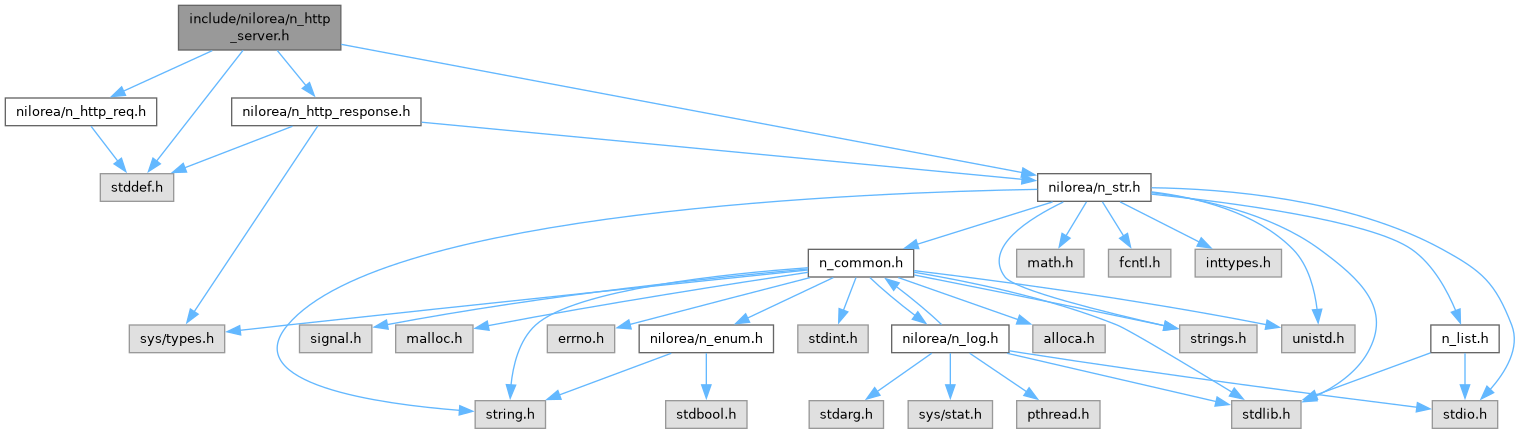
#include "nilorea/n_http_req.h"#include "nilorea/n_http_response.h"#include "nilorea/n_str.h"#include <stddef.h>Go to the source code of this file.
Data Structures | |
| struct | N_HTTP_SERVER_CONFIG |
| server settings; start from n_http_server_config_defaults() More... | |
| struct | N_HTTP_SERVER_REQUEST |
| a request as the handler sees it (fields are read-only) More... | |
| struct | N_HTTP_SERVER_STATS |
| counters, see n_http_server_stats() More... | |
Typedefs | |
| typedef N_HTTP_RESP *(* | n_http_server_handler) (struct N_HTTP_SERVER_REQUEST *req, void *user) |
| the application: build the response for a request; NULL means 500 | |
Functions | |
| void | n_http_server_config_defaults (N_HTTP_SERVER_CONFIG *cfg) |
| fill a config with the defaults documented on each field | |
| void | n_http_server_free (N_HTTP_SERVER **srv) |
| free a stopped server and set *srv to NULL | |
| const char * | n_http_server_header (const N_HTTP_SERVER_REQUEST *req, const char *name, size_t *len) |
| a request header, see n_http_request_header() | |
| N_HTTP_SERVER * | n_http_server_new (const N_HTTP_SERVER_CONFIG *cfg) |
| bind the listening socket and load the TLS context | |
| int | n_http_server_read_body (N_HTTP_SERVER_REQUEST *req, long long max, N_STR **out) |
| read the whole body into memory | |
| int | n_http_server_read_body_to_fd (N_HTTP_SERVER_REQUEST *req, long long max, int fd) |
| read the whole body into an open file descriptor (for uploads) | |
| int | n_http_server_run (N_HTTP_SERVER *srv) |
| serve until n_http_server_stop(): start the workers, accept, then stop accepting, let the workers finish their current request, close idle connections and join them | |
| void | n_http_server_stats (N_HTTP_SERVER *srv, N_HTTP_SERVER_STATS *out) |
| copy of the counters | |
| void | n_http_server_stop (N_HTTP_SERVER *srv) |
| ask the server to stop; async-signal-safe, any thread | |
HTTP/1.1 server: TLS or plain, deadlines, limits, keep-alive.
One accept loop hands sockets to a fixed pool of worker threads through a bounded queue; a connection keeps its worker for its whole life, so the pool size is the connection cap, and a full queue refuses new connections. Every socket operation is non-blocking under a deadline: the TLS handshake, the request head (counted from its first byte), the body, each response and the keep-alive wait each have a TOTAL time limit, so a peer that trickles one byte at a time gets nowhere. Heads are parsed by n_http_request_parse_ex() (no chunked bodies, no smuggling). Bodies are read only when the handler asks for them, with its own size cap, into memory or a file; a body left unread closes the connection after the response. Keep-alive and pipelining are supported. The server answers 400, 408, 413, 417, 431, 500, 501 (a well-formed method other than GET, HEAD and POST) and 503 itself.
SIGPIPE is blocked in the worker threads only (a peer closing mid-write is an error return, not a dead process); the application's own signal setup is untouched. n_http_server_stop() is async-signal-safe.
Definition in file n_http_server.h.
 1.15.0