|
Nilorea Library
C utilities for networking, threading, graphics
|
|
Nilorea Library
C utilities for networking, threading, graphics
|
Hardened, bounded URL + HTTP/1.x response-head parsing for a safe fetcher. More...
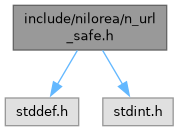
#include <stddef.h>#include <stdint.h>Go to the source code of this file.
Data Structures | |
| struct | n_url_safe |
| The parts of an absolute http(s) URL. More... | |
| struct | n_url_safe_head |
| The response-head fields a fetcher acts on. More... | |
Macros | |
| #define | N_URL_SAFE_HEAD_MAX 16384u |
| Largest response head (status line + headers, through CRLFCRLF) accepted. | |
| #define | N_URL_SAFE_HOST_MAX 253u |
| Longest hostname / IP literal accepted (RFC 1035 limit). | |
| #define | N_URL_SAFE_MAX 1024u |
| Longest URL / path / Location accepted. | |
| #define | N_URL_SAFE_MIME_MAX 127u |
| Longest captured Content-Type (mime), parameters dropped. | |
Functions | |
| int | n_url_safe_find (const char *text, size_t len, char *out, size_t cap) |
| find the first http(s) URL in a block of text | |
| int | n_url_safe_head_parse (const char *buf, size_t len, n_url_safe_head *out) |
| parse an HTTP/1.x response head from [buf, buf+len) | |
| int | n_url_safe_parse (const char *url, size_t len, n_url_safe *out) |
| parse an absolute http(s) URL [url, url+len) into a bounded struct | |
| int | n_url_safe_resolve (const char *base, size_t base_len, const char *loc, size_t loc_len, char *out, size_t cap) |
| resolve a redirect Location against a request URL | |
Hardened, bounded URL + HTTP/1.x response-head parsing for a safe fetcher.
A deliberately narrow, non-allocating companion to the general n_url API (n_network.h) – for the kind of program that fetches an ATTACKER-SUPPLIED http(s) URL (link previews, webhooks, avatar imports, ...). Where n_url_parse is a full, allocating URL model (query params, canonicalize, build), these fill a caller-owned stack struct, reject SSRF / phishing vectors (userinfo, non-http(s) scheme, bad host/port), and cap every field – so a hostile URL or server response can neither over-read nor allocate. Pair with n_ssrf to classify the resolved address, and drive the sockets/TLS in the caller.
Provides: split an absolute URL into parts, parse the response head (status + the few headers a fetcher acts on), resolve a redirect Location, and find the first URL in a block of text.
Definition in file n_url_safe.h.
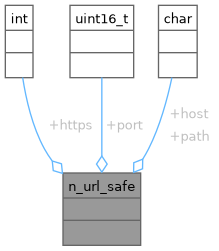
| struct n_url_safe |
The parts of an absolute http(s) URL.
host is the bare hostname or IP literal (an IPv6 literal has its brackets stripped); path includes any query, with the fragment dropped and defaulting to "/".
Definition at line 59 of file n_url_safe.h.
| Data Fields | ||
|---|---|---|
| char | host[253u+1] | |
| int | https | 1 = https (default port 443), 0 = http (80) |
| char | path[1024u+1] | |
| uint16_t | port | |
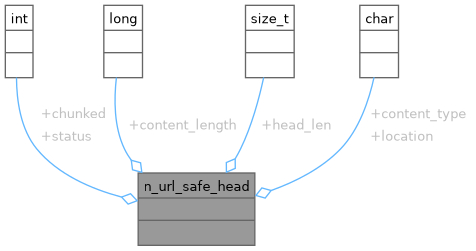
| struct n_url_safe_head |
The response-head fields a fetcher acts on.
Definition at line 67 of file n_url_safe.h.
| #define N_URL_SAFE_HEAD_MAX 16384u |
Largest response head (status line + headers, through CRLFCRLF) accepted.
Definition at line 54 of file n_url_safe.h.
Referenced by n_url_safe_head_parse().
| #define N_URL_SAFE_HOST_MAX 253u |
Longest hostname / IP literal accepted (RFC 1035 limit).
Definition at line 48 of file n_url_safe.h.
Referenced by n_url_safe_parse().
| #define N_URL_SAFE_MAX 1024u |
Longest URL / path / Location accepted.
Definition at line 50 of file n_url_safe.h.
Referenced by main(), and n_url_safe_parse().
| #define N_URL_SAFE_MIME_MAX 127u |
Longest captured Content-Type (mime), parameters dropped.
Definition at line 52 of file n_url_safe.h.
| int n_url_safe_find | ( | const char * | text, |
| size_t | len, | ||
| char * | out, | ||
| size_t | cap ) |
find the first http(s) URL in a block of text
Writes it to out (cap includes the NUL). Trailing sentence punctuation is trimmed. The candidate must pass n_url_safe_parse (so a userinfo / malformed URL is skipped, and scanning continues), which makes this a safe trigger: it never surfaces a URL n_url_safe_parse would reject.
| text | the text to scan |
| len | its length |
| out | output buffer for the found URL |
| cap | capacity of out (including the NUL) |
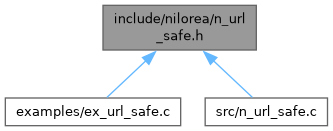
Definition at line 344 of file n_url_safe.c.
References ci_prefix(), and n_url_safe_parse().
Referenced by main().
| int n_url_safe_head_parse | ( | const char * | buf, |
| size_t | len, | ||
| n_url_safe_head * | out ) |
parse an HTTP/1.x response head from [buf, buf+len)
Returns 1 only when a complete head (through CRLFCRLF) is present and the status line is well-formed; 0 if incomplete, malformed, or larger than N_URL_SAFE_HEAD_MAX. On success out->head_len is the offset of the body. Header names are matched case-insensitively; unknown headers are ignored. Bounded and over-read safe.
| buf | the received bytes |
| len | number of bytes in buf |
| out | the parsed head to fill |
Definition at line 230 of file n_url_safe.c.
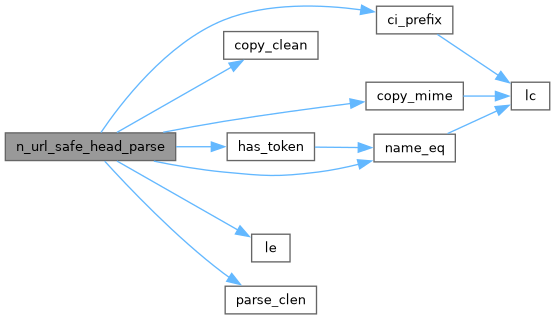
References n_url_safe_head::chunked, ci_prefix(), n_url_safe_head::content_length, n_url_safe_head::content_type, copy_clean(), copy_mime(), has_token(), n_url_safe_head::head_len, le(), n_url_safe_head::location, N_URL_SAFE_HEAD_MAX, name_eq(), parse_clen(), and n_url_safe_head::status.
Referenced by main().
| int n_url_safe_parse | ( | const char * | url, |
| size_t | len, | ||
| n_url_safe * | out ) |
parse an absolute http(s) URL [url, url+len) into a bounded struct
Rejects a non-http(s) scheme, userinfo ("user@host" – an SSRF / phishing vector), an empty or over-long host, a bad port, control bytes, and anything longer than the caps. IPv6 literals in brackets are accepted (brackets stripped into host).
| url | the URL bytes |
| len | number of bytes in url |
| out | the parsed URL to fill |
Definition at line 76 of file n_url_safe.c.
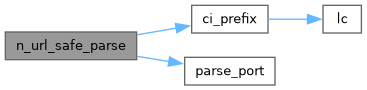
References ci_prefix(), n_url_safe::host, n_url_safe::https, N_URL_SAFE_HOST_MAX, N_URL_SAFE_MAX, parse_port(), n_url_safe::path, and n_url_safe::port.
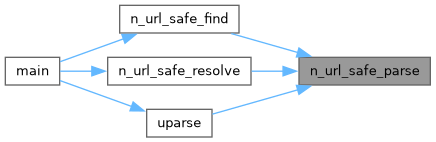
Referenced by n_url_safe_find(), n_url_safe_resolve(), and uparse().
| int n_url_safe_resolve | ( | const char * | base, |
| size_t | base_len, | ||
| const char * | loc, | ||
| size_t | loc_len, | ||
| char * | out, | ||
| size_t | cap ) |
resolve a redirect Location against a request URL
Handles an absolute http(s) target, a scheme-relative "//host/..." and a root-relative "/path"; a bare relative path is refused (returns 0). The result is re-validated with n_url_safe_parse.
| base | the request URL |
| base_len | its length |
| loc | the Location value |
| loc_len | its length |
| out | output buffer for the absolute URL |
| cap | capacity of out (including the NUL) |
Definition at line 308 of file n_url_safe.c.
References ci_prefix(), n_url_safe::host, n_url_safe::https, n_url_safe_parse(), and n_url_safe::port.
Referenced by main().
 1.15.0