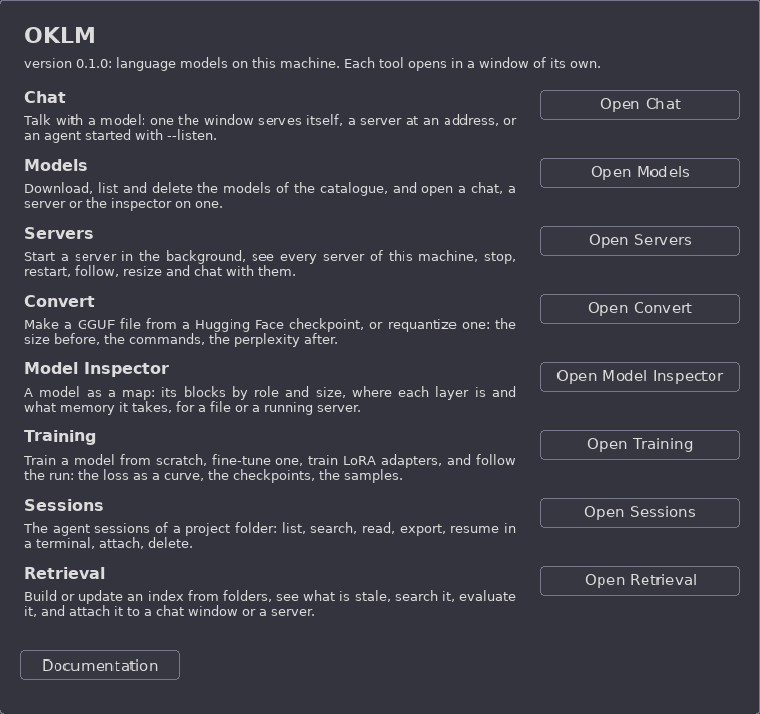
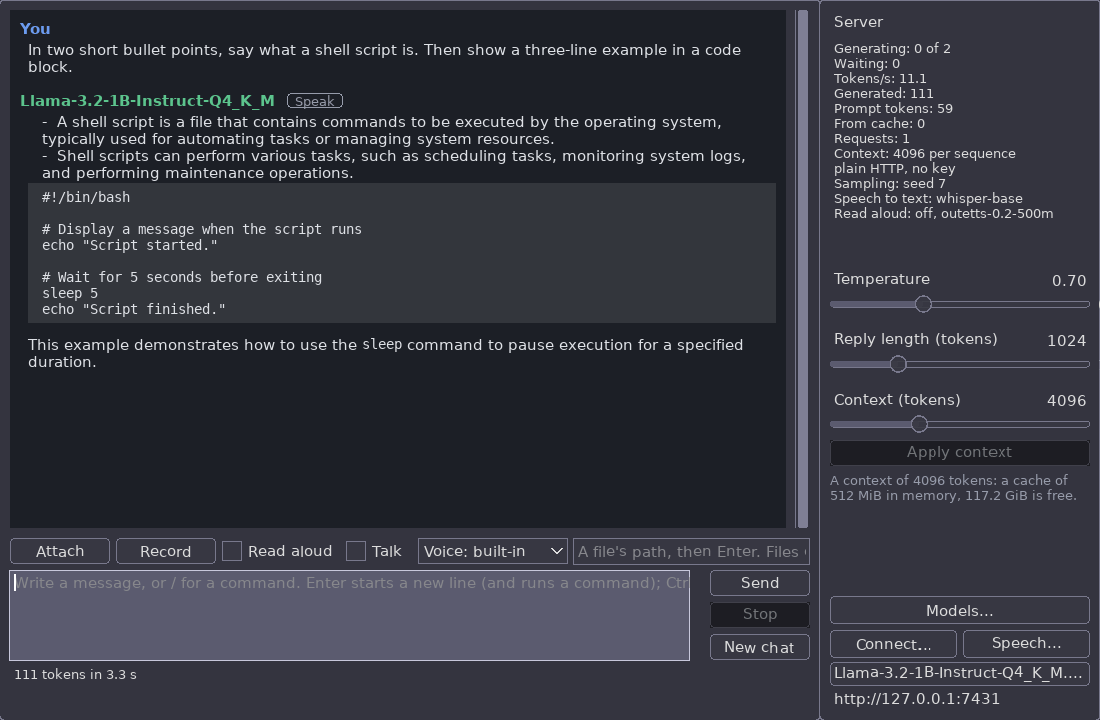
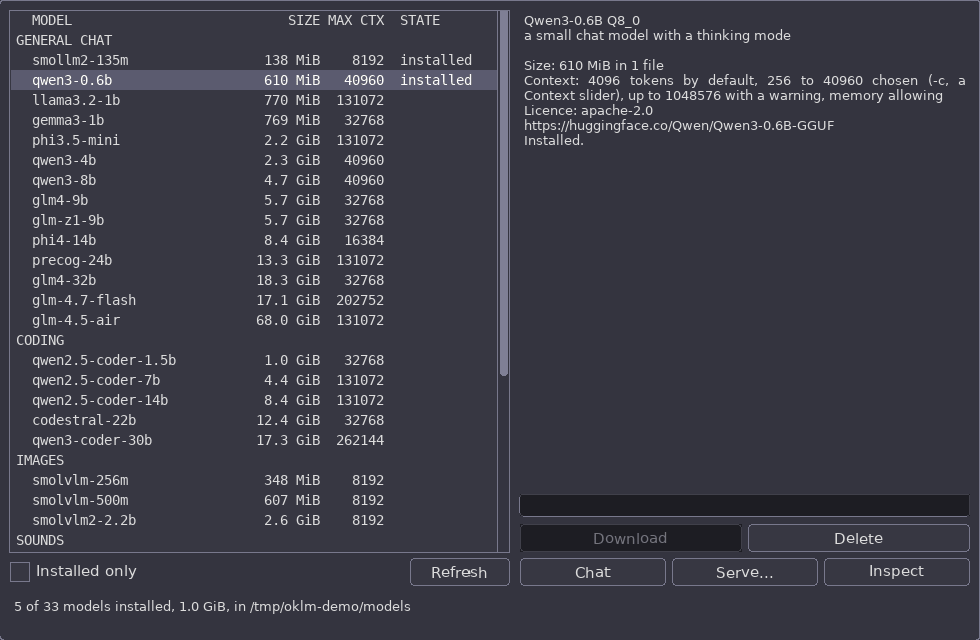
OKLM runs language models locally, on the CPU or the GPU (Vulkan, OpenCL): inference, training and LoRA, quantization and conversion, retrieval over your own documents, an OpenAI-compatible server with a web dashboard, a coding agent, and a desktop application for all of it. Nothing leaves your machine.
Downloads
| File | For | Size | SHA-256 |
|---|---|---|---|
| Linux .deb (Debian 13) oklm_1.0.3-trixie_amd64.deb | Linux | 16.3 MB | a4cbf789eaab6a9517ee1a3e514713cdca7280dc450393c3ba1f47804e1ad2a8 |
| Linux AppImage oklm-1.0.3-trixie-x86_64.AppImage | Linux | 21.4 MB | 7568a54bb7b2c2e6d0e818a46723ec9bc628605b4078df18a76cfc5de1b06efc |
| Windows installer oklm-1.0.3-setup.exe | Windows | 20.5 MB | af976390d8b8f07064d69ebf4c28e0dfebc5adcc73e6a664a42973b9c20851d9 |
What is new
OKLM 1.0.3 release notes
What changed between 1.0.2 (2026-11-17) and 1.0.3: the defects of the
sources that the jobs of CI find and the checks of 1.0.2 did not run,
and nothing of what the programs do. What 1.0.0 holds, the platforms and the promise of
compatibility are in release-notes-1.0.0.md;
they stand, and what 1.0.2 added is in
release-notes-1.0.2.md.
Status: prepared on 2026-11-17, not tagged yet.
Why a version
1.0.2 was tagged on a tree that the server's CI refused: the checks
before its tag built with GCC and analysed with the release machine's
cppcheck and Doxygen, where CI also builds with clang and uses Debian
13's cppcheck and Doxygen.
The packages of 1.0.2 are not at fault (they are built with GCC and
MinGW-w64); its sources did not build with clang. 1.0.3 is the same
programs on sources that pass every job of CI.
Fixed
- The sources build with clang again. A helper of the chats'
commands (src/client/chat_commands.c) passed a format it was given
without saying it takes one, which clang refuses under the build's
warnings and GCC accepts. The fuzzing build, which uses clang, failed
with it. - The static analysis passes with cppcheck 2.17 (Debian 13) as with
2.22: nine places it read as a value used before it is set, an
argument out of a function's domain, an index used before its bound
or an expression it could not parse are written so that both
versions accept them (src/mm/vision.c,src/model/expert_cache.c,
src/model/model.c,src/server/observe_route.c, three headers of
the graphical tools, two tests). None was a defect of a program: no
result changes. - Four places clang's sanitizer stops at: a convolution of the
Whisper encoder and two of the vocoders formed the address of a row
before its buffer for the padding (never read), and the view of a
reply being read aloud added an offset to a null pointer when nothing
had come yet (src/mm/audio.c,src/mm/vocoder.c,
apps/gui/chat_speak.h). The values computed are
the same. - The documentation builds without a warning under Doxygen 1.9
(Debian 13): sixteen comments it did not attach to their symbol, a
helper written between a comment and its function for most of them. - The test of a loop's participants passes on a busy machine
(test_threads): it counted threads that the cap on a loaded
machine (OKLM_CPU_FREE_CAP) had taken away. make testpasses in a tree that is no git checkout (an archive
of the sources): a test of the agent's prompt expected the line that
says the directory is a git repository.
Checks before the tag
The jobs of CI were run in a Debian 13 container on the tree of the tag
less its last commit (this status) before anything was pushed: the
build and the whole suite with GCC and with clang, the formatting, the
static analysis, the documentation and its lint, the fuzzing, and the
three packages. The tag was then set on a commit whose run on the
server was green (roadmap.md). The suite,
the graphical tools' checks and the sanitizer and Wine runs of 1.0.2
stand for what the programs do; the test programs these fixes touch ran
again.
Changed
- The Windows files say what they are.
oklm.exeandoklm-gui.exe
carry a version resource (company NiloreaStudio, product OKLM, their
name, the version), and every file of the Windows folder is without
its debugging sections: the installer is 21 MB where 1.0.2's was 47.
Built where the publisher's key is, the programs, the DLLs beside
them, the installer and its uninstaller are signed with a self-signed
certificate named NiloreaStudio, shipped asNiloreaStudio.cer, and
the installed program's publisher reads NiloreaStudio; the installer
CI builds is signed only if the server was given the key
(build.md, andREADME.mdfor
trusting the certificate). The programs' code is the same.
Packages
As for 1.0.2: built by CI for the tag (oklm_1.0.3-trixie_amd64.deb,
oklm-1.0.3-trixie-x86_64.AppImage, oklm-1.0.3-setup.exe,
SHA256SUMS-1.0.3, attached to the tag's release), and on the release
machine into dist/ (oklm_1.0.3_amd64.deb,
oklm-1.0.3-x86_64.AppImage, oklm-1.0.3-setup.exe).
Known limits
Those of 1.0.2 stand.